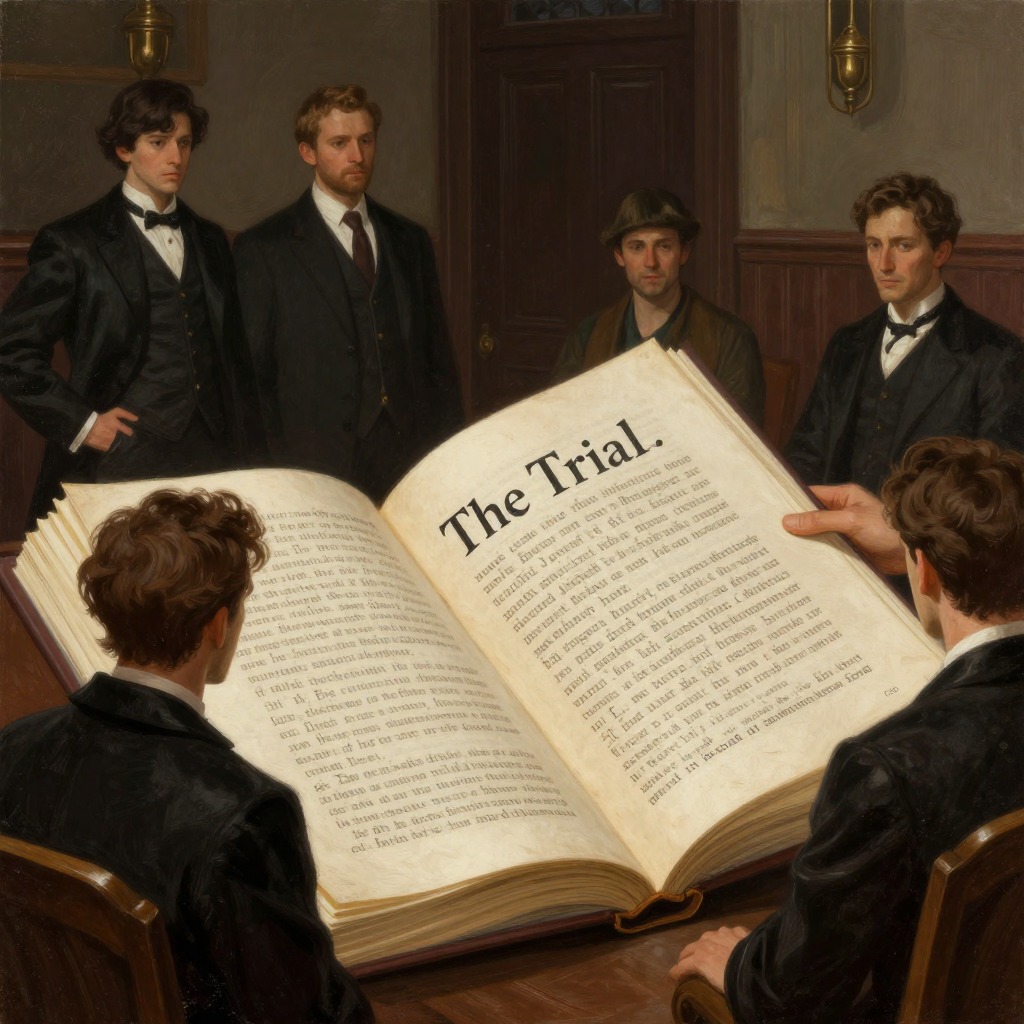
Execution of Josef K.
The execution of Josef K. is the final, inevitable culmination of his year-long trial, a ritualized murder carried out by two anonymous agents on the eve of his thirty-first birthday, in which K. fails to take his own life as expected and dies with the shame of a dog, his final vision a desperate search for a justice he never reached.
The Arrival of the Executioners
On the evening before K.'s thirty-first birthday, at about nine o'clock, when the streets were quiet, two men came to his lodging house. They wore frock coats, were pale and fat, and their top hats looked as if they could not be removed from their heads. After brief formalities at the flat's door, they repeated the same formalities at greater length at K.'s door. K. had not been notified they would be coming, but he sat in a chair near the door, dressed in black as they were, and slowly put on new gloves that stretched tightly over his fingers, behaving as if he were expecting visitors. He immediately stood up and asked them, "You've come for me then, have you?" The gentlemen nodded. K. told them he had been expecting a different visitor. He went to the window and looked down at the dark street; most windows on the other side were already dark, many with curtains closed. In one window on the same floor where a light was on, two small children played inside a playpen, reaching out for each other with their little hands. K. said to himself, "Some ancient, unimportant actors—that's what they've sent for me. They want to sort me out as cheaply as they can." He turned to the two men and asked, "What theatre do you play in?" One of them, pulling in the corners of his mouth, turned to the other for assistance; the other made a gesture like someone who was dumb, struggling with some organism causing him trouble. K. concluded they were not properly prepared to answer questions and went to fetch his hat.
The Journey Through the City
As soon as they were on the stairs, the gentlemen wanted to take K.'s arms, but K. said, "Wait till we're in the street, I'm not ill." They waited only until the front door before they took his arms in a way K. had never experienced before: they kept their shoulders close behind his, twisted their arms around the entire length of K.'s arms, and took hold of his hands with a grasp that was formal, experienced, and could not be resisted. K. was held stiff and upright between them; they formed a single unit of the sort that normally can be formed only by matter that is lifeless. Whenever they passed under a lamp, K. tried to see his companions more clearly. "Maybe they're tenors," he thought as he saw their big double chins. The cleanliness of their faces disgusted him; he could imagine the hands that cleaned them, passing over the corners of their eyes, rubbing at their upper lips, scratching out the creases on those chins. When K. noticed this, he stopped at the edge of an open square, devoid of people but decorated with flower beds. "Why did they send you, of all people!" he cried out, more a shout than a question. The gentlemen clearly knew no answer; they waited, their free arms hanging down, like nurses when the patient needs to rest. "I will go no further," said K. The gentlemen did not need to answer; it was enough that they did not loosen their grip and tried to move him on, but K. resisted. He thought of flies that tear their legs off struggling to get free of flypaper. Just then, Miss Bürstner came up into the square from the steps leading from a small street at a lower level. It was not certain that it was her, although the similarity was great, but it did not matter to K. He suddenly became aware that there was no point in his resistance. There would be nothing heroic about it if he resisted, if he now caused trouble for these gentlemen, if in defending himself he sought to enjoy his last glimmer of life. He started walking, which pleased the gentlemen, and some of their pleasure conveyed itself to him. Now they permitted him to decide which direction they took, and he decided to follow the direction of the young woman in front of them, not so much to catch up with her or keep her in sight, but so that he would not forget the reproach she represented for him. "The only thing I can do now," he said to himself, his thought confirmed by the equal length of his own steps with the steps of the two others, "is keep my common sense and do what's needed right till the end. I always wanted to go at the world and try and do too much, and even to do it for something that was not too cheap. That was wrong of me. Should I now show them I learned nothing from facing trial for a year? Should I go out like someone stupid? Should I let anyone say, after I'm gone, that at the start of the proceedings I wanted to end them, and that now that they've ended I want to start them again? I don't want anyone to say that. I'm grateful they sent these unspeaking, uncomprehending men to go with me on this journey, and that it's been left up to me to say what's necessary." The young woman turned off into a side street, but K. could do without her now and let his companions lead him. All three of them, in complete agreement, went over a bridge in the light of the moon. The moonlight glittered and quivered in the water, which divided itself around a small island covered in a densely-piled mass of foliage and trees and bushes. Beneath them, now invisible, there were gravel paths with comfortable benches where K. had stretched himself out on many summer's days. "I didn't actually want to stop here," he said to his companions, shamed by their compliance with his wishes. Behind K.'s back, one of them seemed to quietly criticize the other for the misunderstanding about stopping, and then they went on. They went up through several streets where policemen were walking or standing; one with a bushy moustache, his hand on the grip of his sword, seemed to have some purpose in approaching the group. The two gentlemen stopped, the policeman seemed about to open his mouth, and then K. drove his group forcefully forward. Several times he looked back cautiously to see if the policeman was following; but when they had a corner between themselves and the policeman, K. began to run, and the two gentlemen, despite being seriously short of breath, had to run with him.
The Quarry and the Ritual
In this way they quickly left the built-up area and found themselves in the fields, which in this part of town began almost without any transition zone. There was a quarry, empty and abandoned, near a building still like those in the city. Here the men stopped, perhaps because this had always been their destination or because they were too exhausted to run any further. They released their hold on K., who just waited in silence, and took their top hats off while they looked round the quarry and wiped the sweat off their brows with their handkerchiefs. The moonlight lay everywhere with the natural peace that is granted to no other light. After exchanging a few courtesies about who was to carry out the next tasks—the gentlemen did not seem to have been allocated specific functions—one of them went to K. and took his coat, his waistcoat, and finally his shirt off him. K. made an involuntary shiver, at which the gentleman gave him a gentle, reassuring tap on the back. Then he carefully folded the things up as if they would still be needed, even if not in the near future. He did not want to expose K. to the chilly night air without moving, so he took him under the arm and walked up and down with him a little way while the other gentleman looked round the quarry for a suitable place. When he had found it, he made a sign, and the other gentleman escorted K. there. It was near the rockface, where a stone lay that had broken loose. The gentlemen sat K. down on the ground, leant him against the stone, and settled his head down on the top of it. Despite all the effort they went to, and despite all the co-operation shown by K., his demeanour seemed very forced and hard to believe. One of the gentlemen asked the other to grant him a short time while he put K. in position by himself, but even that did nothing to make it better. In the end, they left K. in a position that was far from the best of the ones they had tried so far. Then one of the gentlemen opened his frock coat and from a sheath hanging on a belt stretched across his waistcoat withdrew a long, thin, double-edged butcher's knife, which he held up in the light to test its sharpness. The repulsive courtesies began once again: one of them passed the knife over K. to the other, who then passed it back over K. to the first. K. now knew it would be his duty to take the knife as it passed from hand to hand above him and thrust it into himself. But he did not do it. Instead, he twisted his neck, which was still free, and looked around. He was not able to show his full worth, was not able to take all the work from the official bodies; he lacked the rest of the strength he needed, and this final shortcoming was the fault of whoever had denied it to him. As he looked round, he saw the top floor of the building next to the quarry. He saw how a light flickered on and the two halves of a window opened out; somebody, made weak and thin by the height and the distance, leant suddenly far out from it and stretched his arms out even further. Who was that? A friend? A good person? Somebody who was taking part? Somebody who wanted to help? Was he alone? Was it everyone? Would anyone help? Were there objections that had been forgotten? There must have been some. "The logic cannot be refuted, but someone who wants to live will not resist it." Where was the judge he'd never seen? Where was the high court he had never reached? He raised both hands and spread out all his fingers. But the hands of one of the gentlemen were laid on K.'s throat, while the other pushed the knife deep into his heart and twisted it there, twice. As his eyesight failed, K. saw the two gentlemen cheek by cheek, close in front of his face, watching the result. "Like a dog!" he said; it was as if the shame of it should outlive him.